








Concrete Flooring in Barndominiums: Polished vs Stained
In most barndominiums, the concrete slab is both your structural foundation and your finished floor. That makes the decision between polished and stained barndominium concrete floors one of the most important interior choices you’ll make.
- Polished concrete prioritizes durability, light reflectivity, and low maintenance.
- Stained concrete prioritizes color, patterns, and richer decorative effects.
- Slab quality, joint layout, and moisture control must be addressed before any finish.
- Hybrid systems (stained + polished or stained + high-performance sealer) can balance looks and performance.
How Barndominium Concrete Floors Are Different
Unlike conventional homes with crawlspaces or basements, barndominiums are usually slab-on-grade. That means:
- The same slab supports the steel or post-frame shell and serves as the finished floor.
- Crack control, flatness, and joint planning must be coordinated with your final floor design.
- Moisture vapor management from the ground is crucial before any decorative system.
The American Society of Concrete Contractors provides guidance on flatwork, finishing, and decorative systems; see the American Society of Concrete Contractors for technical standards and best practices your builder should follow.
When we develop barndominium plans and designs, we integrate slab specs, control joints, and floor finish selections from day one to avoid costly conflicts later.
Polished vs Stained Barndominium Concrete Floors: Core Differences
What Is Polished Concrete?
Polished concrete is a mechanically refined surface. A crew uses industrial grinders with progressively finer diamond tooling to:
- Cut the surface and remove imperfections.
- Densify the paste with a chemical hardener (lithium/sodium silicate).
- Hone and polish to a matte, satin, or high-gloss finish.
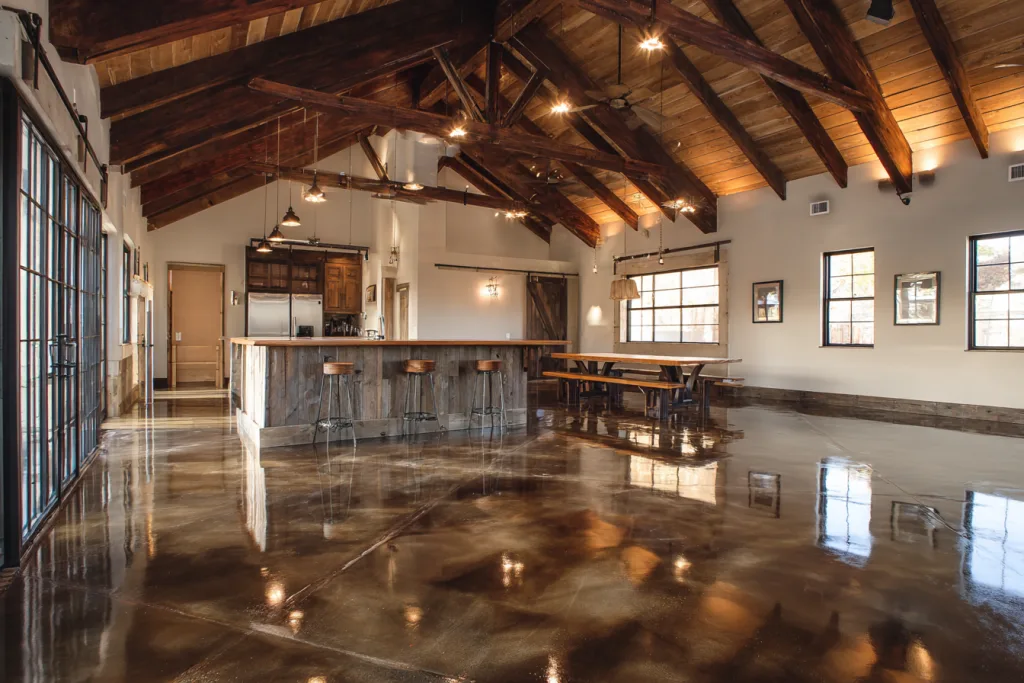
Polished concrete floors provide a sleek, reflective finish ideal for modern barndominium designs.
Performance traits:
- High abrasion resistance and long service life.
- Very low dusting once properly densified.
- Excellent light reflectivity, useful in large open barndo spaces.
- No surface film to peel; the finish is integral to the slab surface.
What Is Stained Concrete?
Stained concrete adds color and visual depth to the slab. Two major systems are used:
- Acid stains – React chemically with the cement paste, producing variegated, earth-toned effects.
- Water-based stains/dyes – Provide more predictable, vibrant, and wider color ranges.
After staining, the floor is typically sealed with either:
- Film-forming sealers (acrylic, epoxy, polyurethane).
- Penetrating sealers (silane/siloxane or combination products).
Performance traits:
- Broad color and pattern design freedom (saw cuts, borders, logos).
- Finish depends heavily on the type and quality of sealer used.
- May require resealing in high-traffic zones.
Side‑by‑Side Comparison for Barndominiums
1. Durability & Wear Resistance
- Polished concrete: Excellent for high-traffic barndo spaces, including shop bays, RV storage, and great rooms. Because the surface is mechanically refined and densified, it resists abrasion and tire tracking better than most sealed-only floors.
- Stained concrete: The stain itself does not add strength; performance is driven by the sealer. High-build urethane or polyaspartic systems can be very durable but are more sensitive to substrate prep and recoat schedules.
Recommendation: If you anticipate heavy tool use, vehicles, or frequent dragging of equipment, polished usually wins on long-term durability.
2. Aesthetics & Design Flexibility
- Polished: Clean, contemporary, often industrial. Aggregate exposure can be controlled: cream finish (minimal aggregate), salt-and-pepper, or full aggregate. Color options come from integral color, topical dyes, or the natural concrete itself.
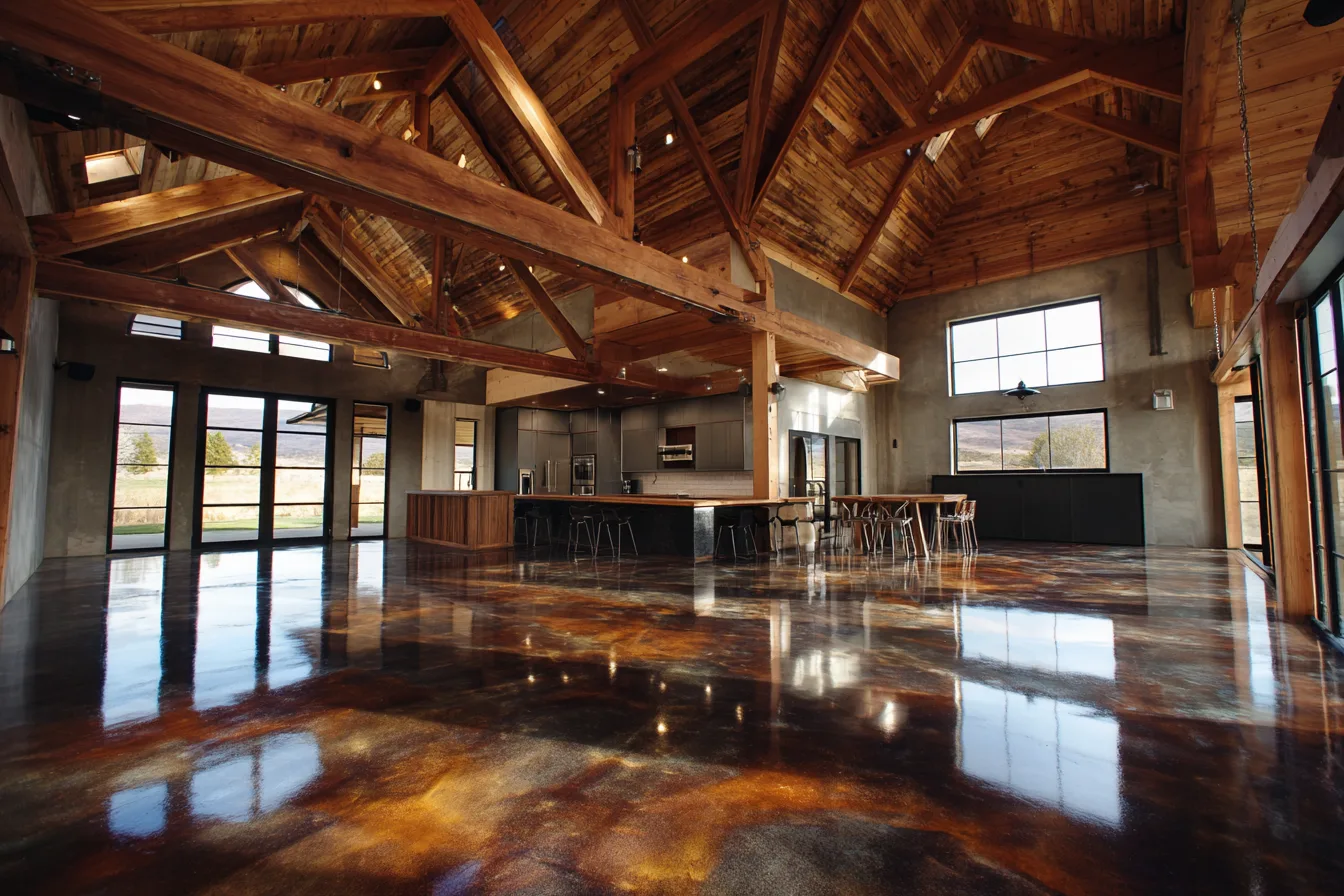
- Stained: Superior for warm, mottled, or rustic looks that many barndominium owners love. You can create faux stone, leather, or wood inspirations, use decorative saw-cut patterns, and vary color room to room.
Recommendation: For modern farmhouse or industrial barndo interiors, polished is ideal. For rustic lodge or Southwest style, stained offers richer visual texture.
3. Maintenance & Cleaning
- Polished:
- Regular dust mopping and damp mopping with a pH-neutral cleaner.
- No wax required; periodic burnishing and occasional guard reapplication in commercial-level use.
- Stained:
- Same day-to-day cleaning approach.
- Expect resealing every 2–5 years in living areas, sooner in shop bays.
- Some high-gloss film sealers show scratches and scuffs more quickly.
Recommendation: If you want the lowest long-term maintenance in living + work areas, polished is typically simpler.
4. Slip Resistance
- Polished: High-gloss polished concrete can be slippery when contaminated with water or oil, but finish level and surface profile can be tuned. Satin or matte levels, along with proper cleaning, maintain acceptable traction. Additional slip-resistant treatments are available for wet areas.
- Stained: Slip resistance is mainly a function of sealer sheen and texture. Matte or low-sheen urethane systems can provide better traction than high-gloss acrylics, and fine-texture additives can be broadcast into the topcoat.
The right surface profile should be chosen with guidance from building and safety standards; trade organizations like the ASCC publish resources on finish selection for different environments.
5. Cost Considerations
Actual pricing will vary by region, slab condition, and barndo size, but in general:
- Polished concrete: Higher upfront labor due to grinding and polishing stages. Costs increase with higher gloss levels and decorative inlays.
- Stained concrete: Lower entry cost for basic single-color acid or water-based stain plus sealer. Multicolor patterns, saw-cut designs, and premium urethanes add to the budget.
Over a 10–15 year service life, polished concrete often becomes more cost-effective due to reduced resealing cycles, especially in mixed-use barndominiums that include shop or barn functions.
Technical Prep: What Your Slab Must Have
Regardless of finish, your contractor should address these items during design and construction:
1. Subbase, Vapor Barrier, and Reinforcement
- Well-compacted subbase to limit settlement and cracking.
- Properly installed vapor retarder or barrier beneath the slab to control moisture transmission.
- Adequate reinforcement (rebar or welded wire) and joint design coordinated with the structural shell.
2. Finishing Standards
Flatness and levelness matter for both polished and stained floors. Over-troweled or burnished slabs can make stain absorption uneven, while heavily pitted or wavy slabs increase grinding time for polished systems.
3. Joint Layout and Crack Management
- Control joints should be strategically aligned with walls, transitions, and decorative saw cuts.
- Random cracks can be stabilized and filled, but they will remain visible and become part of the aesthetic.
When we lay out barndominium interiors, we align joint patterns with the interior plan to minimize awkward lines through kitchens, living rooms, and entryways.
Hybrid and Room‑By‑Room Strategies
Your barndominium doesn’t have to be all polished or all stained. Smart combinations include:
- Polished in shop/garage bays for durability and low maintenance.
- Stained and sealed in living areas for color and warmth.
- Stained borders or patterns within a polished body, using saw cuts to separate colors and finishes.
Another advanced option is to apply dyes or stains and then lightly polish, creating a denser, more wear-resistant surface while preserving color.
Step‑By‑Step Decision Process
Use this quick framework to decide what’s best for your barndo:
- Define use zones. Separate shop, barn, and pure living spaces on your plan.
- Rank priorities. For each zone, decide whether durability, aesthetics, or budget is most important.
- Evaluate slab condition. New, well-finished slabs are ideal; older or rough slabs may favor staining with high-build sealers.
- Assess natural light. Large glass walls benefit from polished reflectivity; darker interiors benefit from lighter stains and satin sheens.
- Plan joints with design. Align control joints with walls, cabinets, and decorative patterns before the slab is poured.
Conclusion: Matching Floor Finish to Your Barndominium Lifestyle
For owners who see their barndominium as both a home and a working building, polished concrete often delivers the best balance of toughness, cleanliness, and long-term value. If your priority is rich color, rustic character, or highly customized patterns, stained concrete is the better artistic canvas—provided you commit to periodic resealing.
The most successful projects begin with the floor in mind during design, not as an afterthought. By integrating slab specs, joint layout, and finish selection from the start, you avoid costly surprises and end up with a barndominium concrete floor that looks intentional, performs hard, and fits the way you live and work.
FAQ: Barndominium Concrete Floors
Are polished concrete floors good for barndominiums?
Yes. They are extremely durable, easy to clean, and well-suited to open-span barndo layouts, especially where living areas and shop spaces are combined.
Can you both stain and polish a barndominium concrete floor?
Yes. Dyes or stains can be applied and then refined with a polishing system. This hybrid approach delivers richer color than polishing alone and better durability than a simple stain-and-seal system.
Will concrete floors feel cold in a barndominium?
Concrete has high thermal mass, so it follows room temperature. With good insulation and optional in-slab radiant heat, polished or stained concrete floors can be very comfortable year-round.


What do you think?
It is nice to know your opinion. Leave a comment.