


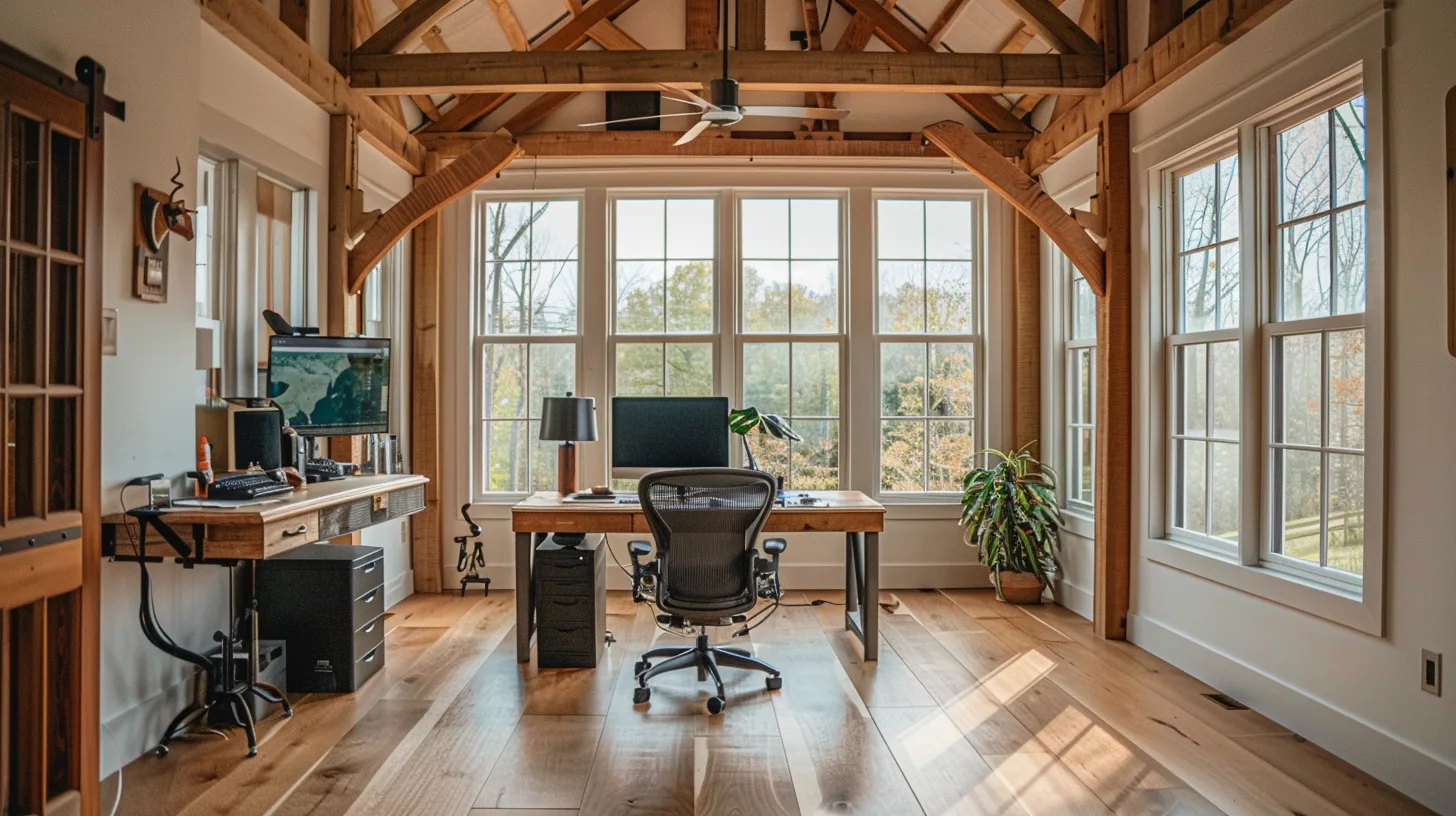






Creating the Perfect Home Office in Your Barndominium
- Plan your barndominium home office at the design stage to get location, noise control, and utilities right the first time.
- Prioritize acoustics, lighting, and storage just as much as square footage for a truly productive workspace.
- Integrate office design with your overall barndo style so it feels cohesive, not like an afterthought.
As remote and hybrid work continue to grow, more barndominium owners are asking for a dedicated, high-performance home office. The open spans and flexible layouts that make barndos so appealing can also introduce acoustic, lighting, and privacy challenges if the office isn’t carefully planned.
This guide walks through practical, build-ready barndominium home office ideas that we use every day when designing spaces for clients. Whether you work from home full-time, run a small business from your shop, or just need a quiet corner for bills and homework, planning your office correctly at the design phase pays off for the life of your barndominium.
1. Choose the Right Location in Your Barndominium
Location is the foundation of a successful home office. Because barndominiums often feature large, open great rooms and shop bays, sound and foot traffic can easily spill into your work area if it’s not well placed.
Smart Placement Strategies
- Separate from high-activity zones: Keep the office away from the great room, kitchen, and kids’ bedrooms whenever possible.
- Leverage corners and ends: End bays of the building, far corners of the floor plan, or rear wings naturally cut down on through-traffic and noise.
- Consider client access: If clients will visit, place the office near an exterior door or entry hall so visitors don’t cross your private living areas.
- Use vertical separation: In two-story barndos, a second-floor office can sit above bedrooms or storage for extra acoustic isolation.
When we help clients select barndominium plans and designs, we always identify an office zone early, then shape circulation and wall construction around it.
2. Plan for Quiet: Acoustics and Privacy
Metal-clad structures and open spans can create echo and sound transmission if the assembly isn’t detailed correctly. For a serious work environment, acoustics are not optional.
Acoustic Construction Upgrades
- Insulated interior walls: Use mineral wool or high-density fiberglass in interior office walls.
- Sound-damping drywall: On the noisiest side of the wall, add a sound-damping layer or double-layer drywall on resilient channels.
- Solid-core doors: Avoid hollow-core doors; specify solid-core with full weatherstripping on the frame.
- Seal the weak spots: Seal around electrical boxes, HVAC penetrations, and bottom plates to reduce air (and noise) leaks.
Simple finishes help too: thick rugs, upholstered seating, and fabric window treatments inside the office help absorb sound and reduce echo, which is especially important for video calls.
3. Dialed-In Lighting for Long Workdays
Lighting quality has a measurable effect on fatigue, focus, and even mood. Thoughtful lighting design should blend natural daylight, ambient lighting, and task lighting.
Natural Light and Windows
- Orient for balanced daylight: North or east-facing windows reduce glare and provide more even light through the day.
- Control glare: Include shades or blinds so you can adjust light during screen-heavy tasks.
- View and ventilation: A window near the monitor (but not directly behind it) gives outdoor views without washing out your screen.
Layered Artificial Lighting
- Ambient: Overhead recessed or surface fixtures with a warm-neutral color temperature (around 3500–4000K).
- Task: Adjustable desk lamp or wall-mounted task lighting to reduce eye strain.
- Accent: Shelf, cove, or picture lighting to give depth and make the office feel finished rather than utilitarian.
Forward-thinking workplaces increasingly pay close attention to lighting quality and worker wellbeing; publications like Fast Company regularly highlight how environment design impacts productivity, and your home office should aspire to the same standard.
4. Electrical, Data, and Technology Infrastructure
Don’t let cords, adapters, and weak Wi‑Fi undermine a beautiful office. For most professionals, the home office is the most tech-intensive room in the barndominium.
Power Planning Checklist
- Multiple duplex receptacles along the desk wall at desktop height for easy access.
- Dedicated circuit if you run high-load equipment (printers, servers, production gear).
- Floor box outlets if your desk will float in the middle of the room.
- USB-C and USB-A charging ports integrated into wall outlets or millwork.
Robust Connectivity
- Hard-wired data: Run Ethernet to the office whenever possible; it’s more stable than Wi‑Fi for video calls.
- Wi‑Fi coverage: Plan access point locations when laying out your building so steel framing or long spans don’t cause dead zones.
- AV and conferencing: Pre-wire for cameras, speakers, or wall-mounted displays if you host virtual meetings.
5. Storage, Built-Ins, and Organization
Clutter is the enemy of focus. Built-in storage lets your office remain a calm, purposeful space instead of a catchall room.
High-Value Storage Ideas
- Full-height cabinets: Integrate tall cabinets for files, supplies, and equipment you don’t want on display.
- Open shelving: Combine closed storage below with open shelves above for books and decor.
- Printer/tech garage: Enclose noisy printers and routers in ventilated cabinets.
- Multi-user stations: Add a second built-in work surface if kids or a partner will share the space.
Because barndominiums often feature generous wall lengths, custom built-ins can run an entire wall, turning what might be a blank expanse into a functional storage and display zone.
6. Integrating Office Style with Your Barndominium Design
The best barndominium offices feel like a natural extension of the home, not a mismatched add-on. Start with the overall design language of your barndo and then decide how strongly you want the office to echo or contrast it.
Design Directions That Work Well in Barndos
- Modern farmhouse: Shiplap feature wall, painted built-ins, warm wood desk, black hardware.
- Industrial: Exposed structural steel accents, concrete-look flooring, metal and wood shelving.
- Rustic: Reclaimed wood beams, barn door (with added acoustic seals), leather chair, warm color palette.
- Minimalist: Clean-lined cabinetry, concealed storage, neutral palette to keep focus on work.
We often start with the client’s preferred exterior and interior themes, then design an office that carries those materials and colors inside in a slightly more refined, professional way.
7. Multi-Use Office Ideas for Barndominiums
Many owners want the office to flex for guests, hobbies, or homeschooling. You can absolutely design it as a multi-function space—as long as work remains the primary design driver.
Smart Multi-Use Strategies
- Office + guest room: Use a Murphy bed or high-quality sleeper sofa; keep the desk as the visual focus.
- Office + craft room: Add a secondary worktable and closed storage to hide supplies when not in use.
- Office + study: Create a built-in desk wall for kids opposite your own workstation, with dedicated task lighting.
Clear zoning—using rugs, lighting, or a partial partition—helps each function feel intentional, not squeezed in.
8. Design Early, Build Once
The most cost-effective time to implement these barndominium home office ideas is at the design and planning stage, before framing and utilities are set. That’s when we can:
- Optimize the office location relative to noise and circulation.
- Specify wall assemblies and doors for privacy and sound control.
- Lay out electrical and data exactly where you’ll need them.
- Integrate windows, built-ins, and lighting into the overall plan.
If you’re still comparing layouts, explore our barndominium plans and designs to see how dedicated offices, flex rooms, and loft workspaces can be woven seamlessly into your barndo.
As building codes, work patterns, and technology keep evolving, successful home offices will continue to reward thoughtful planning and professional design. By treating your office as a mission-critical space rather than leftover square footage, your barndominium can support the way you really live and work—today and for years to come.
Frequently Asked Questions About Barndominium Home Office Ideas
How big should a barndominium home office be?
For a single user with standard equipment, 100–140 sq. ft. (roughly a 10′ × 10′ to 10′ × 14′ room) is comfortable. If you plan seating for clients, dual desks, or large format printers, 150–200 sq. ft. gives more flexibility. The exact size depends on your workflow and storage needs.
Can I put my office next to the shop bay?
You can, but you’ll need enhanced sound control and separation. Use a fully insulated wall between the shop and office, upgrade to solid-core doors, and consider a small buffer zone like a mudroom or storage area between the spaces. This keeps tool noise and fumes from impacting your work.
What flooring works best in a barndo office?
Engineered wood, high-quality vinyl plank, or carpet tiles are common choices. If your slab is polished concrete in the rest of the barndo, adding a large area rug inside the office significantly improves acoustics and comfort while keeping the industrial aesthetic.


What do you think?
It is nice to know your opinion. Leave a comment.